The recommended preventive activities for Aboriginal and Torres Strait Islander people are often earlier or more intensive because of the higher prevalence and earlier onset of several chronic diseases. Care should be holistic, culturally safe and consider physical, social and emotional wellbeing.
- Health assessment
- Offer a comprehensive Aboriginal and Torres Strait Islander health assessment under MBS Item 715.
- This should address the patient’s priorities and include relevant history, examination, investigations, preventive care, interventions and follow-up.
- Item 715 is available provided an equivalent Aboriginal and Torres Strait Islander health assessment has not been performed in the previous 9 months.
- For expanded detail: Medicare Item 715 · Closing the Gap
- Cardiovascular disease
- Assess individual cardiovascular risk factors at least annually from age 18 years.
- Use the Australian CVD Risk Calculator from age 30 years.
- Consider increasing the estimated risk category if the calculated risk is close to a treatment threshold and additional risk-enhancing factors are present.
- From age 50 years, screen for atrial fibrillation by pulse palpation; if irregular, confirm with ECG or ECG rhythm strip.
- For expanded detail: Screening for Cardiovascular Disease · Cardiovascular Health
- Type 2 diabetes
- From age 18 years, screen opportunistically and/or annually using:
- fasting blood glucose, or
- HbA1c.
- Do not use AUSDRISK as the screening strategy for Aboriginal and Torres Strait Islander adults.
- In children aged 10 years or older or from puberty, screen if additional risk factors for type 2 diabetes are present.
- For expanded detail: Screening for Diabetes · Endocrine and Metabolic Health
- From age 18 years, screen opportunistically and/or annually using:
- Chronic kidney disease
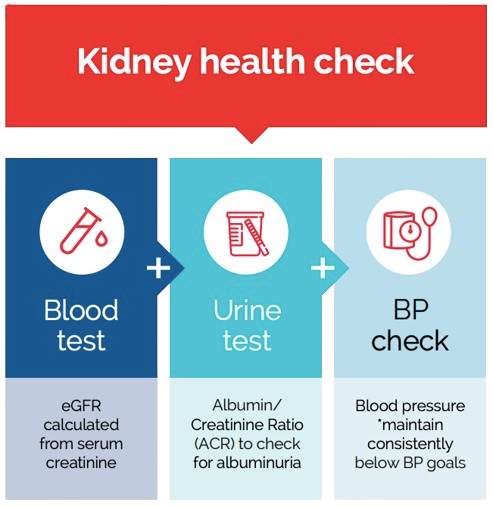
- From age 18 years, perform a Kidney Health Check at least annually:
- blood pressure
- eGFR
- urinary albumin:creatinine ratio (uACR).
- An abnormal uACR should be confirmed with repeat testing because albuminuria may be transient.
- For expanded detail: Screening for CKD · Renal / Urology
- From age 18 years, perform a Kidney Health Check at least annually:
- Cancer screening
- Bowel cancer: screen people aged 45–74 years with FIT every 2 years through the National Bowel Cancer Screening Program.
- Cervical cancer: people with a cervix aged 25–74 years should undergo HPV-based cervical screening every 5 years if eligible. Self-collection is an option for routine screening.
- Breast cancer: offer BreastScreen according to age and individual risk; screening mammography can be considered from age 40–49, with routine population screening focused on ages 50–74.
- Prostate cancer: discuss PSA testing using shared decision-making, taking age and family history into account.
- Lung cancer: the National Lung Cancer Screening Program commenced in July 2025. Consider low-dose CT screening for eligible people aged 50–70 years who currently smoke or quit within the previous 10 years and have a smoking history of at least 30 pack-years.
- For expanded detail: Colorectal Cancer Screening · Cervical Cancer Screening · Breast Cancer Screening · Prostate Cancer Screening · Oncology
- Liver disease
- Assess risk for hepatitis B and hepatitis C and test where indicated.
- Consider metabolic liver disease and follow up abnormal liver function tests appropriately.
- People at sufficiently high risk of hepatocellular carcinoma require surveillance according to current liver cancer guidance.
- For expanded detail: Hepatitis B · Hepatitis C · Gastrointestinal Health
- Eye health
- Assess visual health regularly, with particular attention to diabetes-related eye disease.
- Aboriginal and Torres Strait Islander people with diabetes should have annual diabetic retinopathy screening.
- For expanded detail: Ophthalmology
- Ear health and hearing
- Be proactive about ear disease and hearing loss, particularly in children and in communities with a high prevalence of otitis media.
- Assess hearing when clinically indicated and ensure appropriate follow-up.
- For expanded detail: Ear Health · ENT
- Social and emotional wellbeing
- Assess social and emotional wellbeing as part of routine and structured health assessments.
- Use culturally appropriate, strengths-based assessment and management.
- Recognise connection to family, community, culture and Country as important protective factors.
- For expanded detail: Bio-Psycho-Social Approach to Holistic Care · Mental Health / Psychiatry
- Lifestyle and preventive health
- smoking and vaping
- alcohol
- nutrition
- physical activity
- weight
- sleep
- gambling and other relevant psychosocial risks.
- For expanded detail: Risk Factors · Smoking Cessation Medications · Chronic Alcohol Abuse
- Immunisation
- Follow the routine National Immunisation Program schedule plus Aboriginal and Torres Strait Islander-specific recommendations.
- Important additional recommendations include:
- influenza: annually from 6 months of age
- meningococcal ACWY and B: additional recommendations apply through childhood and adolescence
- hepatitis A: recommended for children in specified jurisdictions
- hepatitis B: vaccinate non-immune, previously unvaccinated adults
- pneumococcal: one dose of 21vPCV for all Aboriginal and Torres Strait Islander adults aged 25 years and over
- RSV: vaccination is recommended for Aboriginal and Torres Strait Islander adults aged 60 years and over.
- Check the current Australian Immunisation Handbook because vaccine products and funded schedules change frequently.
- For expanded detail: Immunisations