
Prostate cancer is now the most commonly diagnosed cancer in Australia. In 2025, approximately 28,900 men were expected to be diagnosed and 4,000 to die from the disease; lifetime risk of diagnosis by age 85 is approximately 1 in 5. Five-year survival is about 96%. Prostate cancer deaths now exceed breast cancer deaths in Australia.
Australia released new NHMRC-approved Guidelines for the Early Detection of Prostate Cancer in May 2026. These supersede the 2016 PSA guidelines and are more proactive than the older RACGP position, while still requiring informed decision-making rather than a population screening program.
- Average risk – age 50–69
- Discuss the benefits and harms of PSA testing.
- If the patient chooses testing → PSA every 2 years.
- PSA <3.0 ng/mL → repeat in 2 years.
- PSA ≥3.0 ng/mL → repeat in 1–3 months.
- If the elevation is confirmed → offer referral for further investigation.
- Age 45–49
- Routine testing is not recommended in average-risk men.
- If an average-risk man is concerned and wishes to be tested:
- PSA <1.0 ng/mL → no further testing until age 50
- PSA ≥1.0 ng/mL → repeat in 1–3 months
- persistent elevation → consider referral.
- Higher risk
- Offer PSA every 2 years from age 45.
- Higher risk includes:
- brother with prostate cancer
- father diagnosed <65 years
- ≥2 second-degree relatives who died from prostate cancer
- BRCA2 mutation
- Black sub-Saharan African ancestry.
- In men aged 50–69 at higher risk:
- PSA ≥2.0 ng/mL → repeat in 1–3 months
- if confirmed → consider referral.
- Family histories containing prostate, breast, ovarian or Lynch-associated cancers should raise suspicion of inherited cancer risk.
- For expanded detail: Genetic Counselling
- Age ≥70
- Do not apply a simple stop rule.
- Decide according to:
- life expectancy
- comorbidity
- previous PSA results
- individual values and preferences.
- PSA testing is generally appropriate only where life expectancy is >7 years.
- PSA ≥5.5 ng/mL → repeat in 1–3 months; if confirmed, consider referral.
- Before repeating an elevated PSA
- PSA may be transiently elevated by:
- UTI / prostatitis
- recent ejaculation
- bicycle riding or vigorous exercise
- anal sex / prostate stimulation
- recent prostate instrumentation or biopsy
- DRE.
- Correct or avoid reversible causes before repeating the test.
- The current national guideline specifies repeat PSA in 1–3 months rather than requiring a fixed “3 days abstinence” rule.
- PSA may be transiently elevated by:
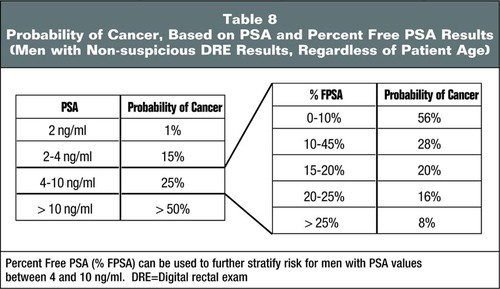
- Free-to-total PSA
- Most PSA circulates either free or protein-bound.
- Lower % free PSA → greater probability of prostate cancer.
- Higher % free PSA → more likely benign prostatic enlargement.
- Free-to-total PSA is particularly useful when total PSA is moderately elevated and the decision to investigate further is uncertain.
- Current MBS criteria use free/total PSA <25% as part of eligibility for Medicare-funded prostate MRI in several PSA ranges.
- <25% is therefore a useful action threshold, not a diagnostic threshold for cancer.
- What happens after a persistently elevated PSA
- Refer to urology.
- Contemporary investigation usually proceeds to multiparametric MRI (mpMRI) before biopsy.
- MRI:
- identifies suspicious lesions
- provides a PI-RADS score
- allows calculation of PSA density
- helps determine whether biopsy is required
- permits targeted biopsy of suspicious areas.
- Biopsy remains the definitive diagnostic test.
- Medicare-funded prostate MRI
- Medicare-funded mpMRI for suspected prostate cancer must currently be requested by a:
- urologist
- radiation oncologist, or
- medical oncologist.
- For a man <70 at average risk, current MBS criteria include:
- 2 PSA results 1–3 months apart >3.0 ng/mL, and
- either free/total PSA <25% or repeat PSA >5.5 ng/mL.
- Different thresholds apply with relevant family history and at age ≥70.
- Medicare-funded mpMRI for suspected prostate cancer must currently be requested by a:
- Digital rectal examination
- DRE is not recommended as a routine addition to PSA screening by GPs in asymptomatic men.
- It remains useful in the specialist diagnostic assessment when prostate cancer is suspected.
- A normal DRE does not exclude prostate cancer.
- Symptoms are not screening
- haematuria
- haematospermia
- persistent urinary symptoms
- unexplained pelvic or back pain
- concerning clinical findings.
- These require diagnostic assessment, regardless of age or previous PSA screening.
The useful exam skeleton is:
- Average risk 50–69 → PSA q2y
- PSA ≥3 → repeat 1–3 months → persistent → urology
- Higher risk → start 45
- 45–49 → action level 1
- Higher-risk 50–69 → action level 2
- Average-risk 50–69 → action level 3
- ≥70 → action level 5.5 + individualise
- Low % free PSA = higher cancer risk
- Persistent PSA → mpMRI before biopsy
- GP DRE ≠ routine screening
Current Key Resources
- PCFA – 2026 Guidelines for the Early Detection of Prostate Cancer in Australia
- PCFA – PSA Testing
- PCFA – Free-to-Total PSA Testing
- RACGP – Red Book, 10th edition
- MBS – Prostate mpMRI
The new thinking on PSA testing
The new thinking is informed by these statistics from AIHW on what has been happening in Australia with prostate cancer.
